Sizing a commercial LED lighting installation
A commercial LED installation is sized from a target DLI and a PPFD map across the bay, never from a wattage. Photosynthetic photon efficacy comes next, since it sets the running cost, then the electrical architecture, which decides what can actually be installed.
Photon efficacy decides the running cost
Photon efficacy is stated in µmol/J: the number of useful photons emitted per joule consumed. At the same DLI and the same area, ten per cent more efficacy means ten per cent fewer kilowatt-hours. A 935 W fixture run for ten hours a day consumes roughly 3.4 MWh a year, to be multiplied by the number of light points in a room.
Total flux (PPF, in µmol/s) is not enough to conclude: what matters at canopy level is PPFD (µmol/m²/s) and its uniformity, measured as a minimum-to-average ratio over the whole bay. Mounting height, spacing between fixtures and wall reflectance weigh as much as the fixture chosen.
Electrical architecture: remote driver and inrush current
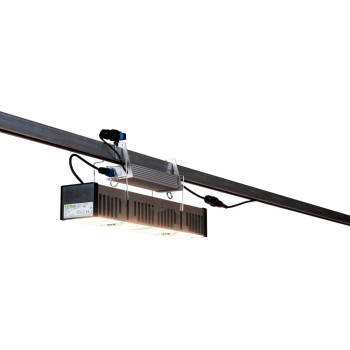
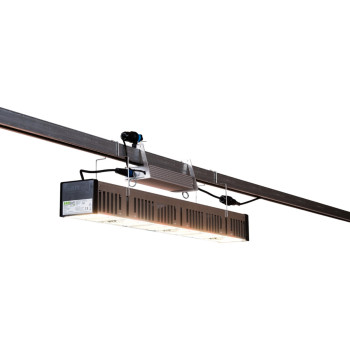
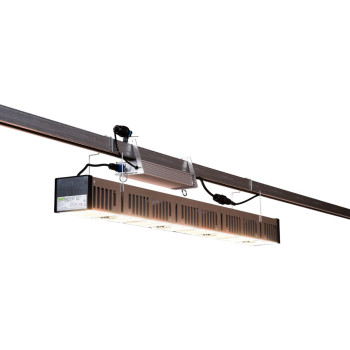
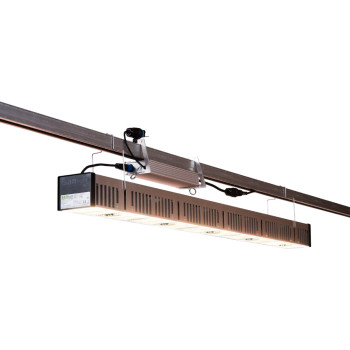
A remote driver takes weight and heat away from the growing plane, allows the driver alone to be replaced and permits maintenance without taking the fixture down. In exchange, the permissible cable length to the module is limited by the manufacturer: a constraint to settle at the layout stage.
Inrush current is the point many installations discover after the fact: at switch-on, several dozen switch-mode drivers simultaneously draw a current far above their nominal rating and trip the protective devices. The usual answers: splitting across several circuits, appropriate breaker curves, staggered switch-on by zone, inrush current limiters. The permissible voltage range (single-phase 230 V, three-phase 400 V, wider industrial ranges depending on the series) is checked on the manufacturer's data sheet.
Dimming and zone control
Two interfaces coexist: analogue 0-10 V dimming, driven per hard-wired group, and DALI, which brings individual addressing and groups that can be reconfigured without rewiring. The protocol actually supported is checked on each model's data sheet. Zone dimming allows sunrise and sunset ramps, setpoints by growth stage and load shedding at peak tariff.
Service in the room, warranty, maintenance
An IP65 rating covers standard water jets, not the high-pressure washing common in glasshouses: the point is checked model by model. Passive cooling removes the fan, and with it the moving wear part, but not the maintenance: the fins get dirty. Almost all the power consumed ends up as heat in the room, which reappears in the sizing of cooling and dehumidification.
Three items belong in the contract rather than being inferred from a sales sheet: the warranty period, the guaranteed photon flux maintenance (flux retained after a stated number of hours, of the L90 type) and the availability of spare drivers. A service life quoted without a measurement criterion commits nobody.
What is listed today
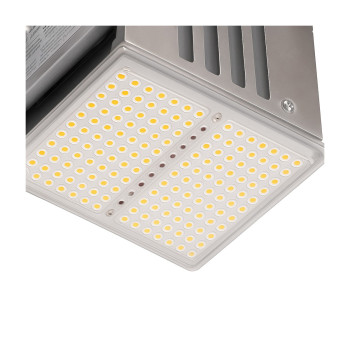
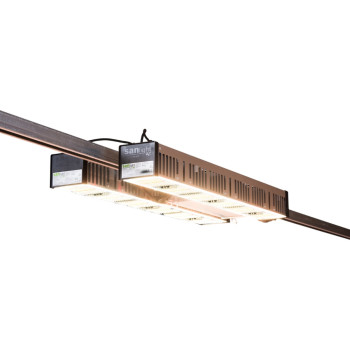
The section is built on the SANlight EVO COMPACT S1W series: six fixtures, from the 2C to the 6CX, with power ratings running from roughly 320 to 935 W depending on the manufacturer's revision. Austrian manufacture, passive cooling, IP65, remote driver. Exact power, flux and voltage range are given on each model's data sheet. Daisy-chain connectors and dimming accessories cannot be ordered online: they are defined during the study, so please consult us before ordering. Supplied to order, shipped on a pallet, lead time stated on the quotation.
Where to go next
Setpoints by growth stage are established with our technical team for a given crop; centralised dimming is prepared alongside grow room automation. For a domestic installation, the general LED lighting range answers a different need. Back to the professional range.