




























































Lumatek
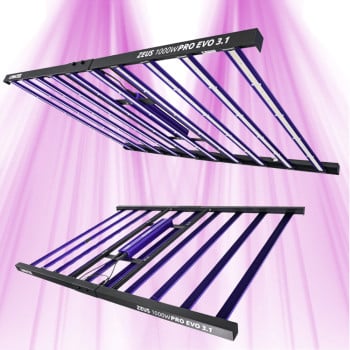
Lumatek ZEUS 1000W PRO EVO 3.1 - Système d'éclairage complet pour la culture en…
Existe en 5 modèles
En stock · Expédié sous 24 h
1 633,50 € ou 3× 544,50 €

Produit ajouté au panier avec succès
Ça pousse dans le bon sens

6 produits
Une superficie d'éclairage 200cm x 200cm représente exactement 4m² de culture indoor, une surface qui demande un éclairage LED puissant et bien réparti. C'est la taille parfaite pour une installation semi-professionnelle ou pour un cultivateur expérimenté qui veut optimiser ses rendements sur une belle surface. Avec 4m², on sort clairement du hobby pour entrer dans du sérieux.
Sur 200cm x 200cm, l'uniformité de l'éclairage devient cruciale. Un mauvais choix de lampe et vous vous retrouvez avec des zones sombres sur les bords ou un hotspot au centre qui brûle vos plantes. Les LED modernes permettent d'atteindre facilement 400-600 µmol/m²/s sur toute la surface, là où les anciennes HPS de 600W peinaient à éclairer uniformément les coins. La consommation électrique reste raisonnable : comptez entre 240W et 480W selon vos objectifs de rendement, contre 600-1000W minimum en HPS pour la même surface.
L'avantage des LED sur cette superficie, c'est aussi la gestion thermique. Avec 4m², la chaleur peut vite devenir problématique, surtout en été. Les LED dégagent 2 à 3 fois moins de chaleur que les lampes traditionnelles, ce qui simplifie grandement la ventilation et réduit les coûts de climatisation.
Pour éclairer efficacement 4m², plusieurs options s'offrent à vous. Vous pouvez opter pour une seule lampe LED puissante de 480-600W avec un angle de diffusion large, ou répartir la puissance avec 2 à 4 lampes plus petites. Cette dernière solution offre souvent une meilleure uniformité et plus de flexibilité pour ajuster l'éclairage selon les zones.
La hauteur de suspension joue un rôle clé : trop haut et vous perdez en intensité, trop bas et vous créez des zones de brûlure. Pour une lampe de 480W sur 4m², comptez 60-80cm de hauteur en croissance et 40-60cm en floraison. Le PPFD idéal se situe entre 400-600 µmol/m²/s en croissance et 600-900 µmol/m²/s en floraison selon vos variétés.
Côté spectre, privilégiez les lampes full spectrum avec un bon ratio rouge/bleu. Les modèles récents intègrent souvent des UV et de l'infrarouge qui boostent la production de résines et la densité des fruits. Pour 200cm x 200cm, évitez les lampes avec des lentilles trop focalisées qui créent des hotspots.
Pour une couverture uniforme sur 4m², optez pour une lampe LED de 480-600W avec un angle de diffusion de 120° minimum. Les modèles avec des diodes Samsung LM301B ou LM301H réparties sur une grande surface offrent la meilleure uniformité. Évitez les lampes trop compactes qui concentrent la lumière au centre. Une alternative efficace consiste à utiliser 4 lampes de 150W chacune, positionnées aux quatre coins de votre espace pour éliminer totalement les zones d'ombre.
La hauteur optimale dépend de la puissance de votre lampe et du stade de croissance. Pour une lampe de 480W sur 200x200cm, suspendez-la à 70-80cm en croissance pour obtenir 400-500 µmol/m²/s, puis descendez à 50-60cm en floraison pour atteindre 700-800 µmol/m²/s. Utilisez un luxmètre ou un PAR meter pour vérifier l'uniformité : l'écart entre le centre et les bords ne doit pas dépasser 20%. Si vous constatez des différences importantes, ajustez la hauteur ou orientez légèrement la lampe.
Sur 4m², vous pouvez cultiver 16 à 25 plantes selon votre méthode. En SOG (Sea of Green), comptez 25 plantes en pots de 11L avec une croissance courte de 2-3 semaines. En SCROG (Screen of Green), 9 à 16 plantes suffisent avec une croissance plus longue et un palissage horizontal. Pour du LST classique, 4 à 9 grosses plantes en pots de 20-30L exploiteront parfaitement l'espace. L'éclairage LED permet de jouer sur la densité car la pénétration lumineuse est excellente même dans un couvert végétal dense.
Les lampes full spectrum modernes sont largement suffisantes pour toute la culture sur 4m². Elles intègrent déjà le spectre rouge nécessaire à la floraison (660-730nm) en proportions optimales. Changer de lampe en cours de culture est contraignant et pas forcément rentable. Si vous voulez vraiment optimiser, ajoutez plutôt des barres LED rouges en complément durant les dernières semaines de floraison. Cela booste la production de résines sans perturber le spectre principal. Les lampes avec variateur permettent aussi d'ajuster l'intensité selon les phases.
Un nettoyage mensuel des LED est indispensable pour maintenir l'efficacité lumineuse. Éteignez et débranchez la lampe, attendez qu'elle refroidisse complètement. Utilisez un chiffon microfibre légèrement humide avec de l'alcool isopropylique à 70% pour nettoyer les diodes et le diffuseur. Évitez les produits chimiques agressifs qui peuvent endommager les lentilles. Sur 4m², la poussière et l'humidité s'accumulent rapidement, une LED sale peut perdre jusqu'à 30% de son efficacité. Vérifiez aussi régulièrement les fixations et les câbles, le poids des lampes puissantes sollicite beaucoup les suspensions.
Existe en 5 modèles
Existe en 7 modèles
Existe en 3 modèles
Existe en 2 modèles
Existe en 3 modèles
Aide & conseils
Sur 200cm x 200cm - 4m² — cliquez une question pour voir la réponse.
Pour une surface de 4m², je recommande de viser une puissance LED réelle d'environ 1000 à 1200 Watts. C'est le minimum pour assurer une pénétration lumineuse suffisante et une bonne homogénéité sur l'ensemble de la surface. Si vous visez des rendements très élevés, vous pouvez même monter jusqu'à 1500W, mais il faudra alors bien gérer la chaleur.
Pour 4m², je privilégie les barres LED ou les panneaux modulaires. Ils permettent une meilleure répartition de la lumière et une gestion plus fine des zones. Je vérifie toujours le PPFD (densité de flux de photons photosynthétiques) moyen sur la surface, qui doit être autour de 800-1000 µmol/m²/s pour une croissance optimale. N'oubliez pas l'efficacité lumineuse (µmol/J) qui est un indicateur clé de la performance.
La distance idéale dépend beaucoup de la puissance de votre LED et du stade de croissance. En général, pour une LED puissante sur 4m², je commence à environ 60-80 cm des jeunes pousses et je descends progressivement jusqu'à 40-50 cm pendant la floraison. L'important est d'observer vos plantes : si les feuilles jaunissent ou se recroquevillent, la lumière est trop intense ou trop proche.
Pour 4m², je conseille un spectre complet (full spectrum) avec un bon équilibre entre le bleu pour la croissance végétative et le rouge pour la floraison. Certains modèles intègrent aussi de l'UV et de l'infrarouge lointain, ce qui peut stimuler la production de résine et la floraison. C'est un aspect crucial pour maximiser les rendements sur une telle surface.
La principale erreur que je vois est de sous-estimer la puissance nécessaire pour 4m². Une autre est de négliger la ventilation : les LED produisent moins de chaleur que les HPS, mais une bonne circulation d'air reste essentielle pour la santé des plantes et la dissipation de la chaleur des drivers. Enfin, ne pas vérifier l'homogénéité de la lumière peut créer des zones de croissance inégales.
Pour 4m², je recommande une installation suspendue avec des systèmes de poulies réglables. Cela permet d'ajuster facilement la hauteur de votre éclairage LED en fonction du stade de croissance de vos plantes. Assurez-vous que le poids de l'équipement est bien supporté et que les câbles sont sécurisés. Une bonne répartition des points lumineux est également clé pour couvrir toute la surface de manière homogène.
Pour 4m², la différence est notable. Les LED offrent une efficacité énergétique bien supérieure, une durée de vie plus longue et un spectre lumineux plus adapté et personnalisable. Les HPS dégagent beaucoup plus de chaleur, ce qui peut être un avantage en hiver mais un inconvénient majeur en été, nécessitant une ventilation plus importante. À long terme, je trouve que les LED sont un investissement plus rentable et performant pour cette surface, notamment pour la culture intensive.
Vous ne trouvez pas votre réponse ? 01 88 33 45 52 ou par message.

Satisfait ou remboursé
14 jours

Livraison offerte
dès 89€*

Livraison
24 à 48H

Paiement
sécurisé

Facilités de
paiement

Meilleurs prix
garantis

Garantie
GrowLED

Points de
fidélité