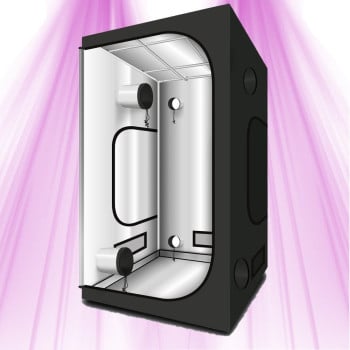
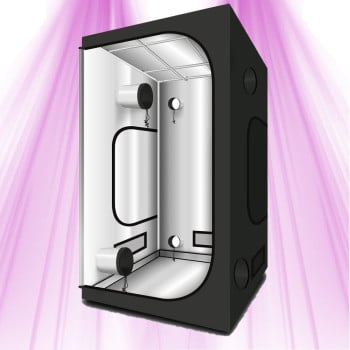
Box de Culture par Formes : Trouvez la Taille Parfaite pour Votre Espace
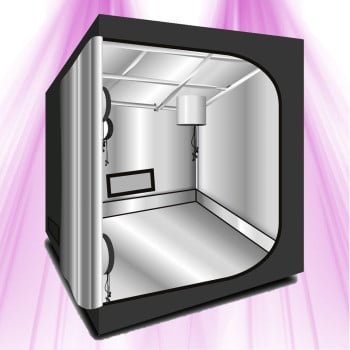
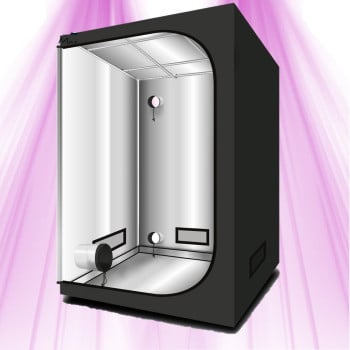
Les box de culture par formes vous permettent d'adapter parfaitement votre installation à l'espace disponible. Que vous ayez un coin de chambre, un placard ou un garage entier, chaque configuration a sa box idéale. Carrées pour maximiser l'espace au sol, rectangulaires pour s'adapter aux recoins, ou compactes pour débuter sans encombrement.
Pourquoi choisir une box adaptée à votre forme d'espace
L'optimisation de l'espace, c'est la base d'une culture réussie. Une box carrée de 100x100 cm exploite mieux un angle de pièce qu'une rectangulaire, tandis qu'une 60x120 cm se glisse parfaitement le long d'un mur. La hauteur joue aussi : 160 cm minimum pour des autoflos, 200 cm et plus pour des variétés qui s'étirent. Franchement, bien choisir sa forme dès le départ évite les galères d'aménagement plus tard.
Les box carrées offrent une répartition lumineuse homogène - votre éclairage LED couvre uniformément toute la surface. Les rectangulaires permettent d'organiser différentes zones : croissance d'un côté, floraison de l'autre. Et les formats compacts ? Parfaits pour tester ses premières graines sans investir dans du gros matériel.
Comment bien choisir sa box selon la forme de votre espace
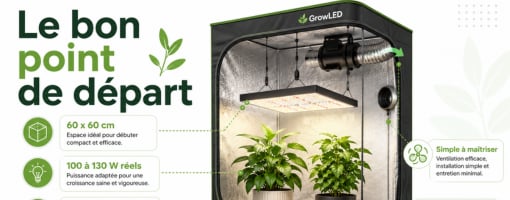
Mesurez d'abord votre espace disponible en gardant 20-30 cm de marge tout autour pour la ventilation et l'accès. Pour un placard de 80 cm de large, visez une box de 60x60 maximum. Un garage ? Là vous pouvez voir grand avec du 150x150 ou même 240x120 cm pour une vraie production.
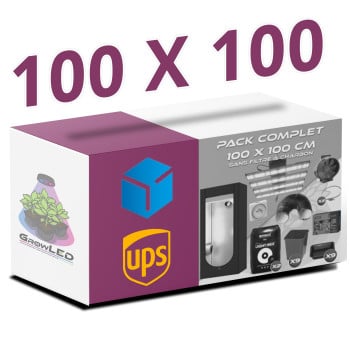
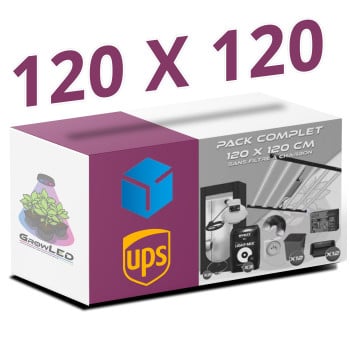
Pensez aussi à la hauteur sous plafond. Une box de 200 cm de haut dans une pièce de 220 cm, ça passe juste pour installer l'extraction en haut. Le nombre de plantes influence le choix : 4 plants en 100x100, 6-8 en 120x120, jusqu'à 12-16 en 150x150 selon la technique de culture. Les débutants partent souvent sur du 80x80 ou 100x100 - c'est gérable sans se prendre la tête.
Questions fréquentes
Quelle taille de box de culture par forme dois-je choisir pour mon espace et le nombre de plantes ?
Comptez environ 25x25 cm par plant en SOG, 50x50 cm en SCROG. Pour 4 plants, une box 100x100 cm convient parfaitement. 6-9 plants demandent du 120x120 cm minimum. Au-delà de 12 plants, partez sur 150x150 cm ou plus. N'oubliez pas la hauteur : 160 cm pour des autoflos, 200 cm minimum pour des variétés photopériodiques qui peuvent doubler de taille en floraison. Gardez toujours 20 cm de marge autour de votre box pour l'aération et l'accès aux équipements.
Comment installer une box de culture comme la Probox sans se compliquer la vie ?
Commencez par vider complètement l'espace et vérifiez que le sol est bien plat. Montez d'abord la structure métallique en suivant le code couleur des barres - généralement noir pour la base, gris pour les montants. Installez ensuite la toile en commençant par le fond, puis les côtés, et terminez par le devant avec la porte. Serrez progressivement tous les raccords une fois la structure complète. Prévoyez 1h30 à 2h pour une box standard, et n'hésitez pas à vous faire aider pour manipuler les grandes toiles.
Quelle est la différence entre une box carrée et une box rectangulaire pour ma culture indoor ?
Les box carrées offrent une meilleure répartition de la lumière - votre panneau LED couvre uniformément toute la surface sans zones d'ombre. Elles conviennent parfaitement aux espaces d'angle et maximisent le nombre de plants au m². Les box rectangulaires s'adaptent mieux aux espaces contraints comme les couloirs ou le long des murs. Elles permettent aussi de créer des zones distinctes : croissance d'un côté, floraison de l'autre. Question ventilation, les carrées sont plus faciles à gérer avec un seul extracteur centré, tandis que les rectangulaires peuvent nécessiter deux points d'extraction sur les grandes longueurs.
Comment bien ventiler ma box de culture pour éviter la surchauffe ?
Installez votre extracteur en haut de la box côté opposé à l'entrée d'air frais, qui se place en bas. Calculez 3 fois le volume de votre box en m³/h minimum - pour une 100x100x200 cm, ça donne 600 m³/h. Ajoutez un variateur pour moduler selon les températures. L'air doit circuler en diagonale : entrée en bas d'un côté, sortie en haut de l'autre. Un ventilateur oscillant à l'intérieur brasse l'air et évite les poches de chaleur. Surveillez que la température ne dépasse pas 28°C en journée, 18-22°C la nuit.
Quel entretien quotidien faut-il pour une box de culture une fois montée ?
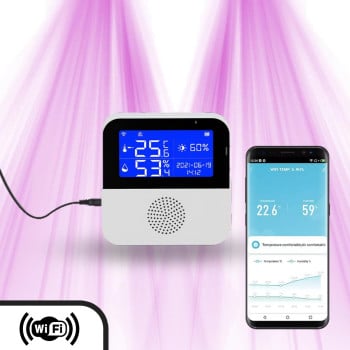
Vérifiez chaque jour la température et l'hygrométrie - 22-26°C et 50-60% d'humidité en croissance, 40-50% en floraison. Contrôlez l'arrosage en testant la terre avec le doigt : si c'est sec sur 2-3 cm, c'est le moment d'arroser. Observez vos plants pour détecter rapidement stress, carences ou parasites. Nettoyez les feuilles mortes et aérez la canopée si nécessaire. Une fois par semaine, vérifiez que les extracteurs ne sont pas encrassés et que l'eau d'arrosage s'évacue bien des soucoupes. C'est 10 minutes par jour maximum, mais c'est ce qui fait la différence entre une culture qui cartonne et une qui galère.